
Blending physical therapy with creativity
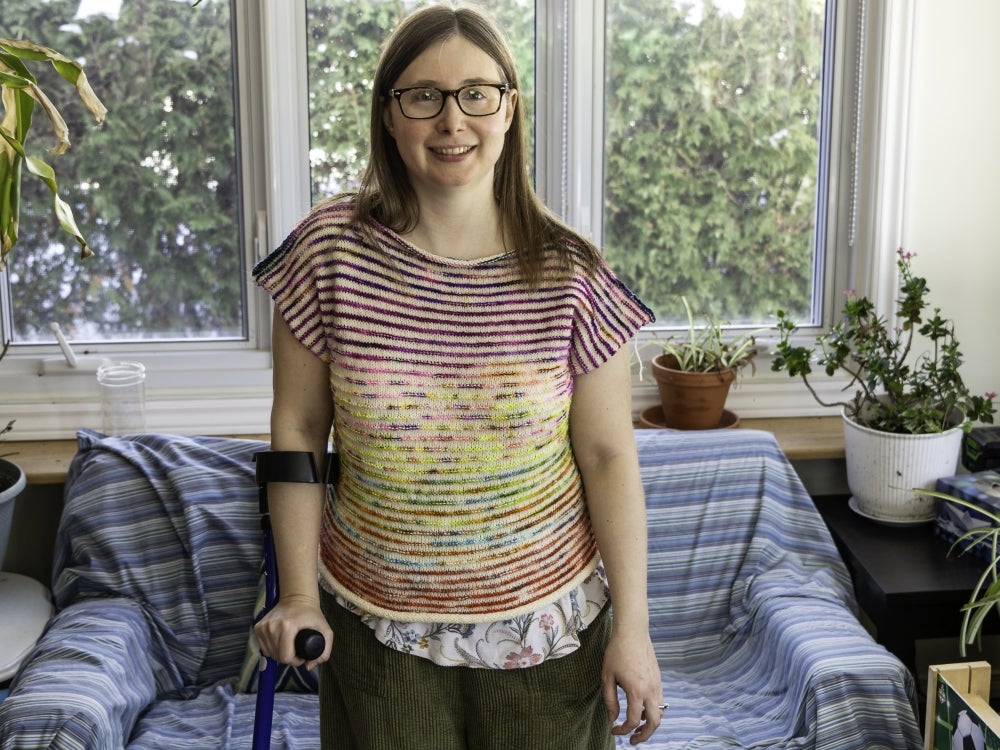
The first time Catherine Sones, 37, felt the excruciating pain of hip subluxation she was nine. "I was facing my bedroom dresser, when my mom called my name. . I turned toward her and the bottom half of me did not follow," she recounted. They rushed to a clinic where a doctor found nothing wrong. He suggested that she had probably pulled a muscle and suggested staying off her feet for a day. A couple of months later it happened again, and this time she was told to rest for 48 hours.
Over the next few years, Sones suffered a variety of similar injuries while doing some of her favourite activities: soccer, ballet and curling. “The motion of curling with a 40-pound rock was particularly challenging,” she said. “I would extend my arm, release the rock and my shoulder would follow.”
Frequent trips to the Montreal Children’s Hospital provided no answers. “At one point I was told by an ultrasound technician that I had torn something, but it was not so severe that it required treatment,” Sones said.
She had no choice but to stop the activities she loved. Swimming was still okay, but she had to re-learn breaststroke because the regular frog-kick caused extreme pain.
At age 14, she suffered an injury in school, and a physician suggested it was psychosomatic. She was referred to a psychologist and art therapist. “After a few sessions, the therapist sent a report back to the doctor saying that there was actually something very wrong with my body,” Sones said. She had noticed that Sones’ fingers bent backwards when holding a pencil.
When she was 19, 10 years after her first joint subluxation, there was finally a diagnosis of Ehlers-Danlos syndrome, a rare genetic condition.
"When you hear hoofbeats, think horses, not zebras" is a medical maxim coined by Dr. Theodore Woodward in the 1940s to teach medical students to prioritize common diagnoses over rare, exotic ones. It advises doctors to assume the most likely causes for symptoms, rather than considering a rare condition.
The symbol for rare diseases is the zebra.
At age 22, Sones was studying English lit- erature at Concordia University and had a part-time job giving out samples at Costco. One day, she was leaning down, under her sample table, when someone bumped it with their shopping cart. She instinctively reached up to catch the cooler to avoid spilling food on the floor. In doing so she dislocated her shoulder.
This injury required surgery followed by months of physio and occupational therapies. Sones found it incredibly boring, doing the same exercises over and over. “My physiotherapist said that if I found an activity I could do with my arms out-stretched in front of me, for 15 minutes at a time, that could replace the repetitive exercises,” she said.
“Both of my grandmothers loved knitting and had taught me to knit when I was a child; it was something I enjoyed and could do instead of physiotherapy.” Her first knitting project was a huge infinity scarf. Then she moved on to a variety of other beautiful, knitted items.
In 2014, Sones launched Zebra Knitting, and began selling her creations at craft fairs. She also learned to crochet so she could make stuffed animals. Zebra.Knitting can be found on Instagram. In addition to the craft fairs, Sones takes on commissions for specific knitted and crocheted items.
She also runs a knitting and crocheting program at the Contactivity Centre for seniors in Westmount, teaches knitting and crocheting to children and adults, and continues to sell at local craft fairs.
Sones and her husband Tom are raising an adorable five-year old son, William.